
15 Minutes of Pilates for Desk-Related Back Tension
Why desk-related back pain comes from stillness rather than «bad posture», why 15 minutes really is enough, and a ready-made mini-routine for your workday.
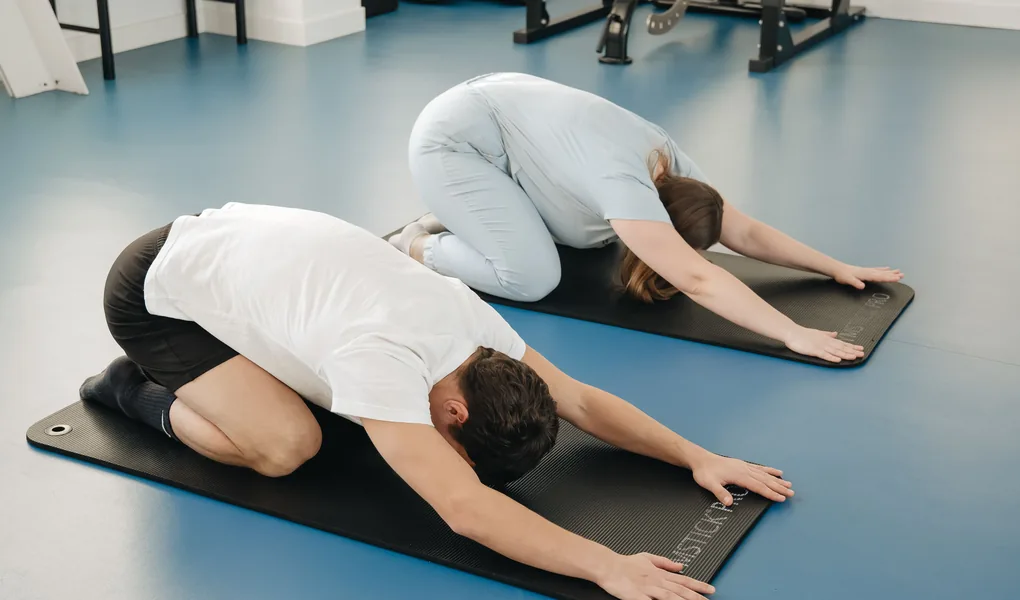
«I must be sitting wrong» or «I need a proper chair» - that's how almost every conversation about desk-related back pain begins. And it's almost never the real reason.
Over the years I've seen hundreds of «office» backs, and the main enemy is always the same - not posture, but stillness. The body doesn't mind a crooked sit so much as a long sit without change. And the good news is that the remedy is simple, short, and free: movement.
The problem isn't posture - it's stillness
The idea that «there's one correct posture and you must hold it» sounds logical but works poorly. Holding your back in any position - even the ideal one - for hours is itself a static load. The tissues get no variation, blood flow in the muscles slows, and they go numb. That's why physiotherapy has long said: the best posture is the next posture.
The numbers back this up. In a study of high-risk office workers (Waongenngarm and colleagues, 2021), introducing active breaks and postural shifts through the day reduced the onset of new neck and low back pain by 55-81% over six months of follow-up. Not a special chair and not «correct posture» - it was regularly interrupting stillness that produced the effect.
Why 15 minutes actually works
The second myth is that exercise only «counts» when it's a full hour at the gym. It doesn't. The WHO's 2020 guidelines dropped the old requirement that activity last at least 10 minutes at a stretch: any movement now counts, and the benefit accumulates from short bouts across the day.
For the back, this is confirmed directly. In an experiment where one weekly hour of strength exercise was distributed in different ways (Andersen and colleagues), short frequent «doses» - down to nine sessions of seven minutes - reduced neck and shoulder pain no less than one long session. And a meta-analysis of micro-breaks (Albulescu and colleagues, 2022) showed that even breaks of under ten minutes reduce fatigue and restore vigor.
So 15 mindful minutes isn't a «better than nothing» compromise. It's a legitimate working dose - if you do it regularly.
What actually seizes up over a workday
For the routine to be more than a random set of exercises, it helps to understand what sitting strains. There are three zones. The neck and upper traps get overloaded because the head reaches forward toward the screen. The thoracic spine rounds and «freezes» in one position. And the lower back and hip flexors shorten from hours of sitting, while the glutes do the opposite - they «switch off» and stop supporting the pelvis.
So the workday mini-routine isn't about «doing crunches» - it's about returning movement to where it disappeared: opening the thoracic spine, unloading the neck, stretching the front of the thigh, and switching the glutes and deep core back on.
A 15-minute mini-routine
Here's one way to split the quarter of an hour. The first 3-4 minutes: breathing and thoracic mobility - smooth trunk rotations and gentle extension over the back of a chair, to release the «frozen» feeling between the shoulder blades.
The next 5-6 minutes: core and glute activation - a bridge, bird-dog variations, gentle work on pelvic stability. That's the support the lower back lacks most by the end of the day.
The last 4-5 minutes: releasing the neck and lower back - drawing the shoulder blades down and together, careful neck mobility, and a hip-flexor stretch. Throughout, technique matters more than speed: move smoothly, no jerks, keep a neutral trunk, and don't work through sharp pain.
When to do it - and why that matters more than the «perfect moment»
The best time is whenever you'll actually do it: in the morning before work, in a gap between calls, or in the evening. But the real leverage isn't only the single 15-minute block. Scattering short one-to-two-minute breaks through the day gives even more: stand up, rotate the trunk, draw the shoulder blades together, take a walk.
Systematic reviews confirm that regular exercise reduces neck pain in office workers - but what works is the sum of movement across the day, not one heroic session a week. So don't wait until your back «locks up»: a short practice is prevention, not first aid.
The bottom line
Desk-related back pain doesn't come from «sitting crookedly» - it comes from sitting for long stretches without moving. The antidote is movement, and it doesn't need to be long. Fifteen honest minutes plus short breaks through the day will give you more than an hour you never get around to.
The goal of this routine is simple: return movement to where the workday took it from, and do it often enough that the body never has time to «freeze». Here, consistency matters more than intensity.
Sources
- Waongenngarm et al. Active breaks and postural shifts to prevent neck and low back pain in office workers (RCT), 2021
- WHO. Guidelines on Physical Activity and Sedentary Behaviour, 2020
- Andersen et al. Frequency and duration of strength training for managing neck and shoulder pain (RCT), Journal of Strength and Conditioning Research, 2012
- Albulescu et al. Efficacy of micro-breaks for well-being and performance (meta-analysis), PLOS ONE, 2022
- Effectiveness of exercise in office workers with neck pain (systematic review and meta-analysis), 2018