
How Many Pilates Sessions a Week? My Answer Is Three
Why three sessions a week (Tuesday, Thursday, Saturday) is the sweet spot, what the research on strength and mobility actually shows, and what to do if three isn't realistic.
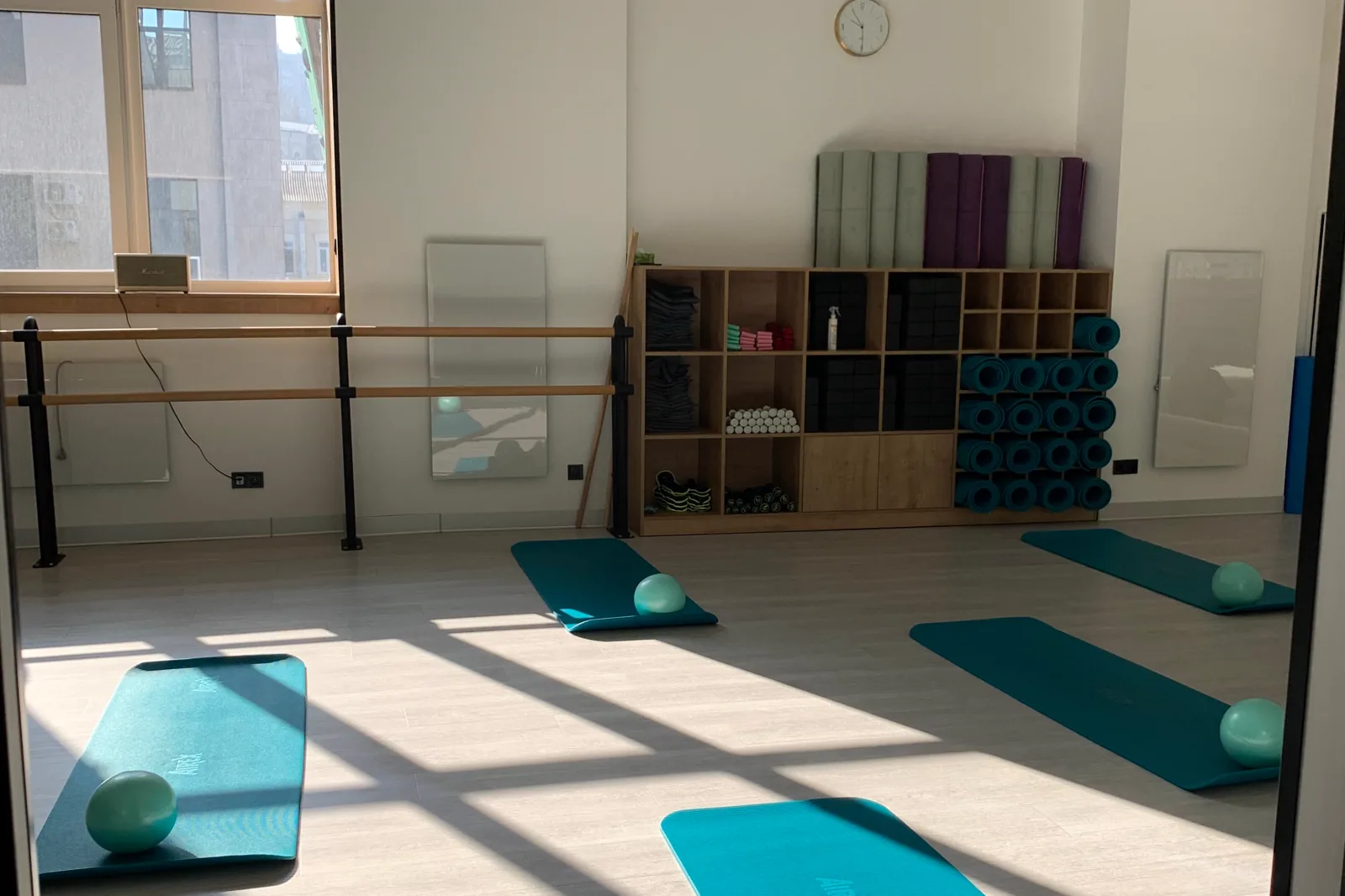
Almost everyone who comes to a first session asks this. Some are ready to train every day and feel let down when they hear «don't rush». Others can only spare an hour once a week and worry it's a waste of time.
After fourteen years of teaching I've arrived at a very concrete answer: Tuesday, Thursday, Saturday. Three sessions a week. And it isn't just a convenient schedule - there's a logic behind it that the research supports well.
Let's start with simple arithmetic
The World Health Organization recommends adults get 150-300 minutes of moderate physical activity a week, plus strengthening exercises for all major muscle groups on at least two days a week.
Now let's count. Two 60-minute sessions is 120 minutes, which doesn't even reach the lower edge of the norm. Three sessions is 180 minutes, which puts you inside the recommended range with a little to spare.
The arithmetic alone explains a lot. Two sessions a week isn't the optimum, it's the minimally acceptable level. The optimum starts a little higher.
Volume decides, and frequency is how you accumulate it
There's a finding in strength-training research that often gets quoted incorrectly. A large meta-analysis of 25 studies (Schoenfeld, Grgic, Krieger, 2019) showed that if total weekly volume is the same, training frequency by itself has almost no effect on the result.
People often draw the wrong conclusion that frequency doesn't matter. The real conclusion is different: volume matters, and frequency is the mechanism you use to accumulate it. The key phrase is «if volume is the same». In real life it isn't. Nobody shows up for two sessions and does one and a half times the usual amount of work, so three sessions a week is simply 50% more work than two.
And where the volume wasn't artificially equalized, the difference is clear. A meta-analysis on strength gains (Grgic and colleagues, 2018) showed that the effect size grows with frequency: 0.74 for one session a week, 0.82 for two, 0.93 for three, and 1.08 for four or more.
Three is the point where the curve has already risen noticeably, but the load still fits comfortably into an ordinary person's life.
Mobility loves frequency especially
If frequency is a nice bonus for strength, for flexibility and range of motion it's essential.
A review of 23 studies (Thomas and colleagues, 2018) showed directly that weekly frequency is positively linked to range of motion, and that it's the total time across the week that determines the result, not the length of a single set. The authors' recommendation is to work on flexibility on at least five days a week.
Five is already a lot for full sessions. But three workouts plus short self-guided sessions on the off days give exactly the distribution connective tissue needs. It responds to a frequent, repeated stimulus, not to one heroic stretch once a week.
Being honest about the study where three didn't beat two
Here I want to be precise, because this study gets quoted a lot. Brazilian researchers (Miyamoto and colleagues, 2016) recruited 296 people with chronic low back pain and split them into groups: a booklet, and pilates once, twice, and three times a week over six weeks. All the pilates groups outperformed the booklet, two sessions were better than one, and three gave no additional advantage over two.
It's an honest result, and I'm not hiding it. But it's important to understand what was actually measured, and what was measured was pain and functional limitation in a clinical group over six weeks. That's a pain-relief task, and the conclusion is very reassuring: to stop your back hurting, two sessions a week is enough. Great news for someone who comes in with pain.
But «the pain stopped» and «a strong, mobile, resilient body» are different goals. Pain relief really does plateau quickly. Strength, endurance, movement control, and range of motion don't - they keep growing with volume, and that's exactly what the strength and stretching meta-analyses are about.
So my logic is this: two sessions to get rid of the problem, three to build a body in which the problem doesn't come back.
Why Tuesday, Thursday, Saturday specifically
It's not a random schedule. There are never more than two days between sessions, so the body doesn't have time to «forget» what it learned. The nervous system holds the movement skill, the muscles stay in tone, and each new session starts not from zero but from where you left off.
One full day to recover after each session matters too. Pilates doesn't create the kind of load that leaves you needing three days off, but a rest day lets the tissues adapt.
The weekend stays partly, not fully, unloaded. Saturday morning is the most stable slot of the week, not eaten up by work meetings and deadlines.
And most importantly, these are fixed days. Not «three times whenever it works out», but Tuesday, Thursday, Saturday. The decision is made once, and after that it runs on habit rather than willpower.
About the trap of ambitious plans
There's data worth keeping in mind precisely because it's inconvenient. A Boston yoga study compared classes once and twice a week. Both groups improved both pain and function, with no difference between them. But here's the interesting part: attendance in the «once a week» group was 73%, and in the «twice a week» group only 62%. The people asked to do more showed up less.
That's exactly why I don't suggest five or six sessions a week to my clients, even though in theory it would give an even bigger effect. A five-session plan falls apart within three weeks, while a three-session plan with fixed days holds up for years. Three is the line where more doesn't yet mean worse.
And if three isn't possible
It isn't possible for everyone, and that's fine.
Two sessions a week is a fully workable format. The low back pain research confirms this directly. Progress in strength and mobility will be slower, but it will be steady.
One session a week also makes sense, especially combined with other activity: walking, swimming, the gym. One session is incomparably better than none.
The compromise that works best: however many sessions you do, add 10-15 minutes of self-guided practice on the off days. Breathing, thoracic mobility, core activation. The stretching meta-analysis points to exactly this - the time accumulated across the week matters more than the length of a single set.
And a little about breaks
One more reassuring thing: results don't disappear instantly. A meta-analysis on detraining showed that after a 2-6 week break, range of motion drops slightly compared with the peak, but stays noticeably higher than the starting level.
A holiday, an illness, or a crunch at work don't reset your progress, they just put it on pause.
In summary
Three sessions a week is the optimum: 180 minutes that fits the WHO norm, enough volume to grow strength and mobility, and no more than two days between sessions. Two is a reliable working minimum, enough to get rid of pain and stay in shape. One works more slowly, but it works.
Fixed days matter more than the count: Tuesday, Thursday, Saturday beat any ambitious «when possible» plan. And consistency over months matters more than the intensity of any single week.
If you're unsure, start with two and add the third after a month, once the habit has formed. That way it almost never breaks.
Sources
- Miyamoto et al. Weekly frequency of Pilates for chronic low back pain (RCT), Physical Therapy, 2016
- da Silva et al. Different weekly frequencies of Pilates and low back pain improvement, Brazilian Journal of Physical Therapy, 2020
- Grgic et al. Resistance training frequency and gains in muscular strength (meta-analysis), Sports Medicine, 2018
- Schoenfeld, Grgic, Krieger. Training frequency and muscle hypertrophy, Journal of Sports Sciences, 2019
- Thomas et al. Stretching typology and duration: effects on range of motion, International Journal of Sports Medicine, 2018
- Saper et al. Once- versus twice-weekly yoga for chronic low back pain, Evidence-Based Complementary and Alternative Medicine, 2013
- WHO. Guidelines on Physical Activity and Sedentary Behaviour, 2020
- Detraining effects following chronic stretching on range of motion (meta-analysis)