
Pilates and Posture: How to Fix Rounded Shoulders Without Pain
Why poor posture builds up from a sedentary lifestyle, and which specific pilates exercises bring the shoulders and spine back to a comfortable position.
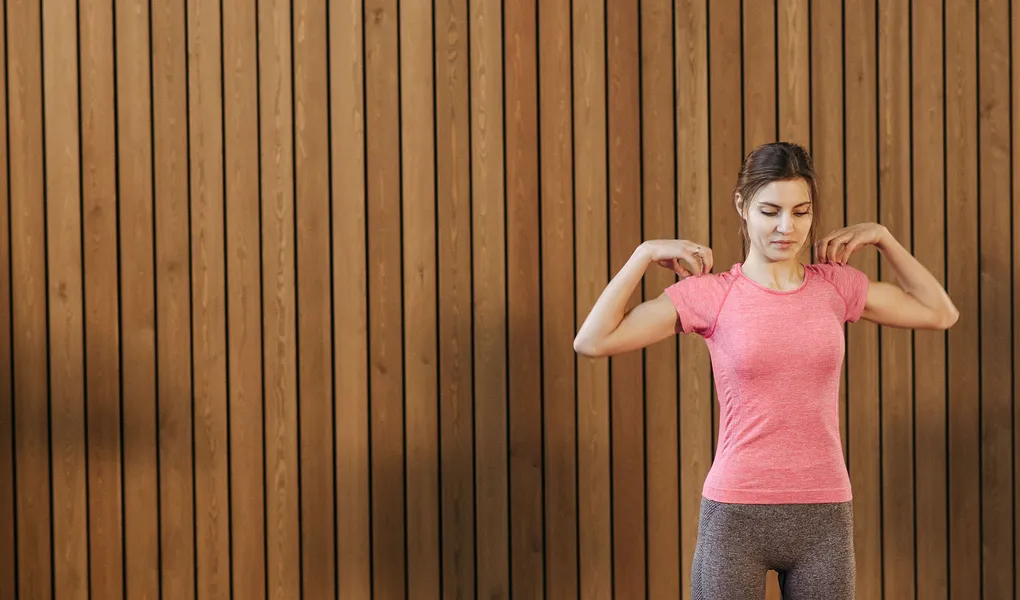
Rounded shoulders and a head pushed forward toward the screen are just about the most typical 'portrait' of the modern person. But before we talk about how to change it, I want to take away some of the fear that has been built up around posture for years.
First, honestly: there is no 'ideal' posture
Fitness and even medical culture have cemented the idea that there's one 'correct' posture, and that any deviation inevitably leads to pain. Modern evidence doesn't support that idea. An editorial in the Journal of Orthopaedic & Sports Physical Therapy (Slater et al., 2019) states plainly that there's no strong evidence that any single spinal shape protects you from pain, and it urges valuing regular movement and relaxed, natural positions over rigid 'stand up straight.'
In other words, the goal isn't to freeze in a perfect posture like a poster - it's to have a body that changes position easily and doesn't get stuck in one. This matters to say, because the fear of 'ruining your back with the wrong sitting' does more harm on its own than the sitting itself.
But rounded shoulders aren't so harmless once they become your only mode
That doesn't mean posture is irrelevant. A meta-analysis (Mahmoud et al., 2019) showed that people with neck pain have, on average, a noticeably more forward head position than those whose necks don't bother them. The problem isn't the shape itself, but that the body forgets how to leave the slumped position - and it's the constant stillness in it that shows up as tension and discomfort.
So the honest way to put it is this: rounded shoulders aren't a 'broken' back - they're a back that lacks the strength and the habit to hold itself differently. And that is very much trainable.
What's actually happening in the muscles
Over the years I keep seeing the same typical pattern, which physiotherapists call the 'upper crossed' pattern. In front, the chest muscles and upper trapezius are shortened and tight; behind, the muscles between the shoulder blades (rhomboids, lower trapezius) and the deep neck flexors are weak and 'asleep.' Under this imbalance, the shoulders round forward. Pilates is good precisely because it works both sides at once: it opens and mobilizes the tight front and strengthens the weakened back.
The key is not to 'hold your back,' but to train it
The most common mistake is trying to straighten up by willpower. You can consciously pull your shoulders back and freeze for half a minute, a few at most, and then your attention shifts - and the body returns to its habitual position. You can't hold posture by tension. It changes another way: by regularly loading the right muscles until an upright position becomes the least effortful for the body - that is, natural by default.
What the science says about exercise, and about pilates
And here the news is good. A meta-analysis (2018, Journal of Manipulative and Physiological Therapeutics) found that therapeutic exercise produces a large improvement in head position angle and moderately reduces neck pain. A broader review of the 'upper crossed' pattern (2024) confirmed that strengthening, stretching, and scapular exercises significantly reduce forward head, rounded shoulders, and excessive thoracic curvature.
There's pilates-specific data too. In a study (Lee et al., 2016), women with desk jobs did pilates three times a week for ten weeks - and significantly improved their head position angle and neck mobility, while the control group showed no change. So this isn't about 'seeming straighter,' but about a measurable change.
The three exercises I usually start with
The Chest Opener over a roller or a rolled-up towel gently stretches the tight front and restores mobility to the thoracic spine. The Swan switches on the back extensors and trains you to hold a neutral spine without straining. The Scapular Squeeze wakes up those mid-back muscles that are most 'asleep' in people who slouch. Together they cover both sides of the pattern - stretching what's shortened and strengthening what's weak.
Desk micro-breaks matter just as much
Because the real enemy of posture isn't a 'wrong' position but freezing in any one position for too long, short breaks become no less valuable than full sessions. A few torso rotations, shoulder-blade squeezes while seated, a couple of deep breaths with the chest opening - two or three minutes several times a day. This puts movement back where it's missing and keeps the muscles from tightening up again between workouts.
Realistic expectations
The first thing clients usually feel is less tension between the shoulder blades and in the neck by the end of the day, within the first week or two. Visibly straighter shoulders appear later, after a few weeks of consistency, and a lasting change of habit is a story of months, not days. And once more: the goal isn't a flawless side-profile photo, but a back that is strong, free, and doesn't get stuck in a slouch.
The takeaway
So don't chase an 'ideal' posture - it doesn't exist, and the fear of sitting is more harmful than sitting itself. Chase something else: a strong upper back, a mobile thoracic spine, and the habit of changing position often. Pilates gives you the first two, micro-breaks the third. It's this combination, not attempts to 'hold your back,' that brings the shoulders back into place - calmly and without pain.
Sources
- Slater et al. 'Sit Up Straight': Time to Re-evaluate, Journal of Orthopaedic & Sports Physical Therapy, 2019
- Mahmoud et al. The relationship between forward head posture and neck pain (systematic review and meta-analysis), Current Reviews in Musculoskeletal Medicine, 2019
- Effectiveness of therapeutic exercise on forward head posture (meta-analysis), Journal of Manipulative and Physiological Therapeutics, 2018
- Effect of exercises on forward head, rounded shoulder, and hyperkyphosis in upper crossed syndrome (meta-analysis), BMC Musculoskeletal Disorders, 2024
- Lee et al. Clinical effectiveness of a Pilates treatment for forward head posture, Journal of Physical Therapy Science, 2016